Contents 6
Fibonacci is a fairly popular technical tool in the FOREX currency market. Its popularity grew after traders ran a number of experiments with its secret mathematics and found that the method has quite a few advantages.
BROKER rating here >> (more than 1,000 reviews from real clients)
Five main ways to trade Fibonacci levels
First, I suggest watching the video on adding Fibonacci in MT4:
More details in a separate article on our site (in Russian).
Fibonacci ratios describe the relationship between trend moves and counter-trend moves: retracements of 38.2%, 50% and 61.8% form the primary levels of a corrective move. Apply these ratios after a trend in either direction to forecast how far the counter-trend swing may go. By drawing a Fibonacci grid on the most pronounced waves up or down, you can see how the Fibonacci percentage levels line up with key price levels.
When chart patterns and Fibonacci retracement levels coincide on the chart, they can point to excellent trade signals. Always analyze highs, lows and moving averages for final confirmation of the importance of a given Fibonacci level.
Disagreement between Fibonacci retracement levels and the main forex chart pattern leads to market noise (corrections) instead of profit. Don’t trade a chart if your analysis produces contradictions. These contradictions eventually lead to a large number of reversals on price charts. Conversely, a strong correlation between Fibonacci levels and forex chart patterns gives you highly predictable reversals at fairly narrow price levels.
I suggest looking at 5 ways that can help you work with Fibonacci levels. Add these 5 ways to your technical toolkit and try to always apply them in your future analysis when trading forex (CFDs, futures). I’m sure they will serve you well for many years and help you earn or save more than a few thousand dollars.
First rise / First failure
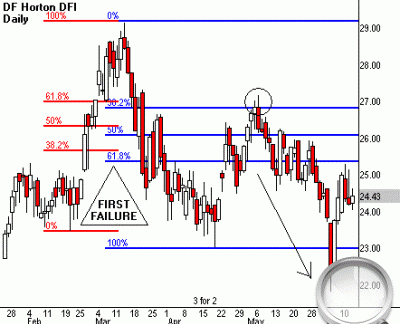
First rise / First failure is the first 100% retracement of the previous trend within your timeframe. It warns of a reversal after a new high or low. A 100% Fibonacci retracement breaks the main direction of price movement and ends the current trend in which consolidation took place. From this Fibonacci level, the previous trend may resume if it breaks through the old 38% Fibonacci level. Forex traders quite often use this level to open a position with small risk against the previous trend.
Hunting the parabola
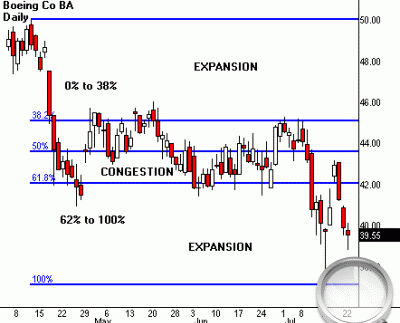
A parabolic move in the forex market can occur between the 0% — 38.2% and 61.8% — 100% Fibonacci levels in all market trends. This pattern offers an excellent opportunity to catch big trends when looking for trades. Always watch for price clusters that form at the 38.2% or 61.8% Fibonacci retracement levels. Then use a simple breakout system as soon as the price leaves this cluster. The next surge can be quite dramatic once the price starts moving back, like a magnet, toward the previous high or low. Of course, this forex strategy only works if you can identify these levels in advance.
Gap extension
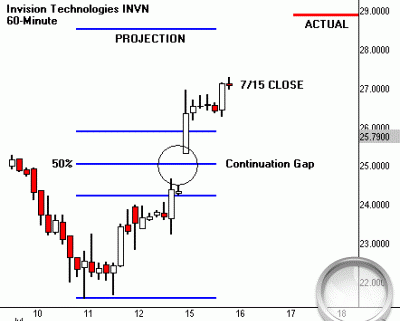
Quite often you can find the exact price at which a rally or decline will end by using gap extension as a Fibonacci extension tool. Identify the gap by placing it at the midpoint of the vertical price wave. Then start drawing the Fibonacci grid at the beginning of the current trend and extend it so that the gap sits under the 50% Fibonacci retracement level. The extension of the Fibonacci grid will show the final price of the rally or decline.
The «night grid»
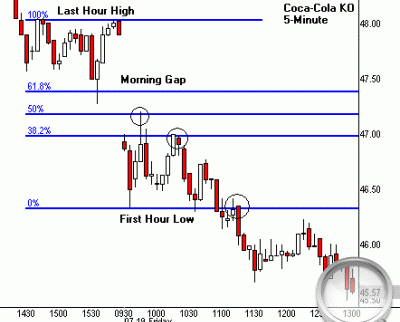
Choose a fairly active instrument and start drawing a Fibonacci grid from the high (or low) of the last trading hour of the session. Then stretch the grid in the opposite direction to the low (or high) of the first trading hour of the next morning. This sets the price waves that a forex trader tends to use to find intraday reversals and intraday breakouts. The «night grid» also offers a strategy for trading the morning gap (between sessions). The gap will often pass through a key Fibonacci retracement level and offer a low-risk entry on a pullback.
Second high / low
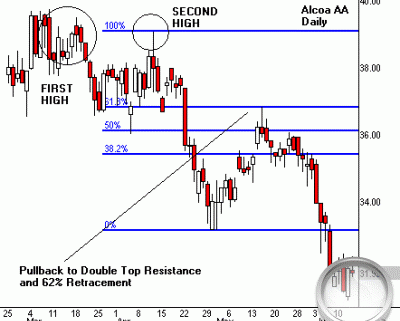
Many forex traders can’t decide where to draw the Fibonacci grid. Here is a trick that will help you draw it in a better place. The absolute high (the highest price) or low of a price wave is not always the best point for drawing a Fibonacci grid on most timeframes. Instead, look for a small «double bottom» or «double top» within the cluster where the current trend started. Place one end of the Fibonacci grid on this 2nd high (or 2nd low) instead of the 1st. This will let you pick the specific Elliott wave that matches the trend you are trying to trade.